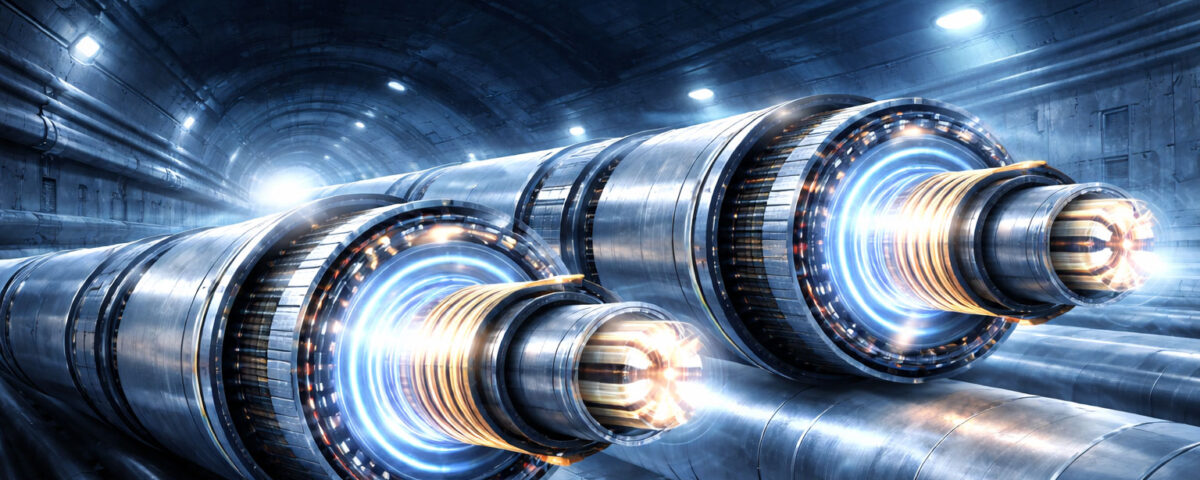
Copper and aluminum are the most common materials used in wiring and power lines today. They are among some of the best electrical conductors, but they are not perfect. As electric current moves through them, it faces resistance. This resistance creates heat, wastes energy, and limits how much power can be delivered.
Superconducting cables remove these limitations. They can carry electricity with zero resistance, allowing more power to flow through a smaller and lighter cable. Because there is no resistance, there is no heat buildup and no voltage loss as electrons travel.
This is made possible by advanced cooling systems that keep the cables at extremely low (cryogenic) temperatures. At these temperatures, the materials inside the cable enter a superconducting state. In this state, electricity flows freely without losing energy.
In this article, we take a closer look at superconducting cables. We cover how they work, how they are made, and how they can help build cleaner and more efficient power systems.
Superconducting Cable Construction
Superconducting cables are not a new idea. They have been studied for decades in fields like energy, transportation, and scientific research. Only recently have advances in manufacturing and cost made them practical for large-scale use.
There are several superconducting cable designs, and new improvements are constantly being developed. Most superconducting cables share the same core components.
Conductor and Core
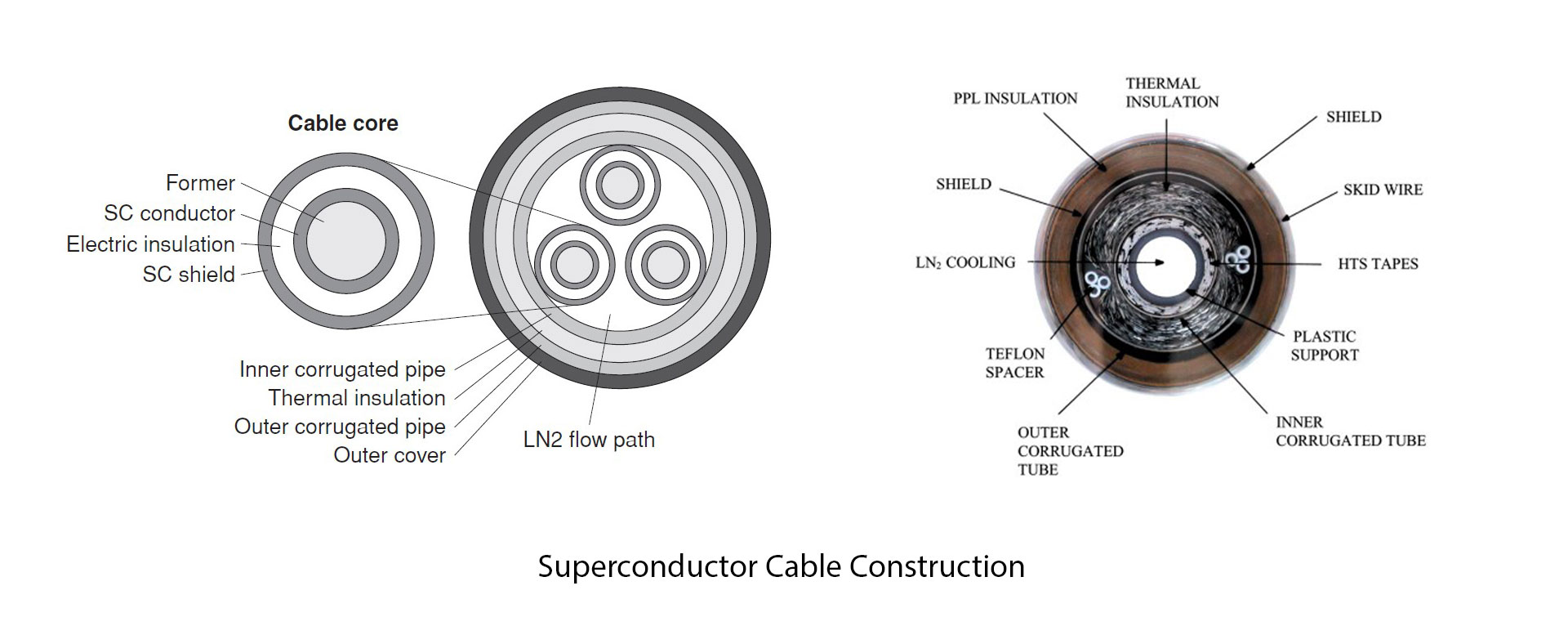
The conductor is the part that carries electrical current. It is made by wrapping superconducting material in a spiral around a central support (called a former).
Common materials include niobium-titanium (Nb-Ti), which is widely used in low-temperature systems, and ceramic-based materials such as rare-earth barium copper oxide (REBCO) and yttrium barium copper oxide (YBCO). These materials become superconducting when cooled to very low temperatures.
Insulation Layer
The insulation layer separates the conductor from other parts of the cable. A common material is polypropylene laminated paper (PPLP). It performs well at low temperatures and has low electrical losses. Insulation may additionally be impregnated with a dielectric fluid in some designs.
Shield Layer
A shield layer is placed around the insulation. It is made by winding superconducting wire in a spiral, using the same type of material as the conductor. This layer carries current in the opposite direction of the main conductor.
The shield cancels out external electromagnetic fields and prevents energy from leaking outside the cable. As a result, superconducting cables can operate with little to no electromagnetic interference and low reactance.
Jacket and Conduit
Multiple cable cores are grouped together and placed inside a protective pipe. This pipe is usually made of corrugated stainless steel.
The cable is built with two layers of piping. A vacuum is maintained between these layers to reduce heat transfer. This helps keep the cable cold and improves overall efficiency.
Cooling System
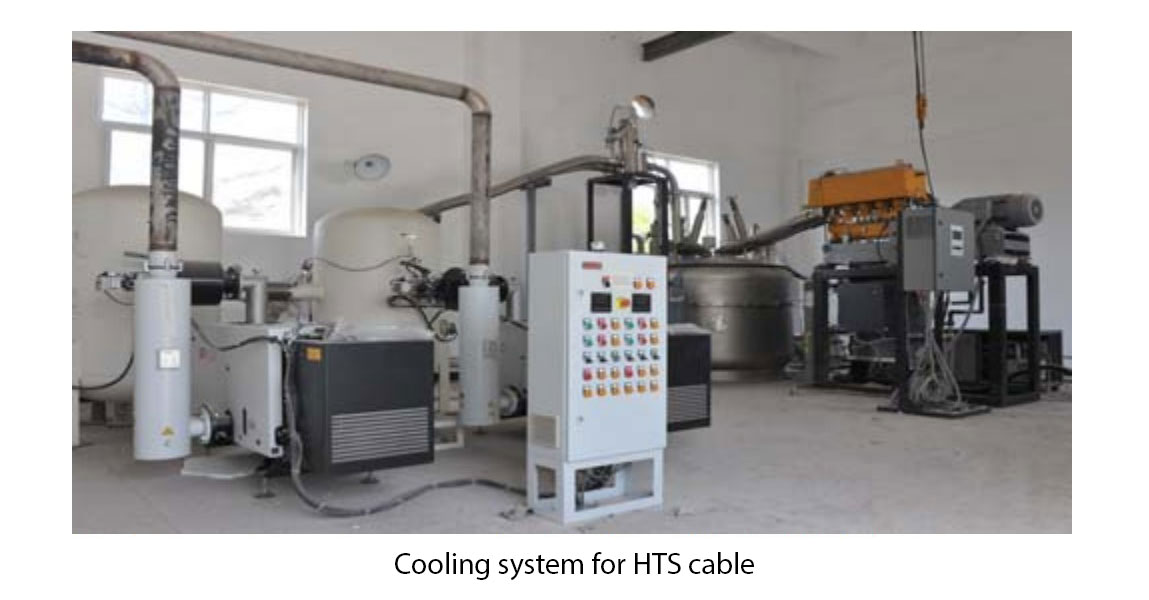
Superconducting cables must stay at very low temperatures to work. This requires a dedicated cooling system that circulates a coolant through the cable.
The system includes pumps, cooling units, and monitoring equipment. Regular maintenance is needed to ensure reliable operation.
Traditional superconductors operate near absolute zero. They are cooled using liquid helium at about 4 K (-269°C). Newer high-temperature superconductors (HTS) operate at higher temperatures, around 77 K (-196°C), which can be achieved using liquid nitrogen.
The term “high temperature” is relative. These materials are still extremely cold compared to everyday conditions. However, using liquid nitrogen makes cooling simpler and more cost-effective.
Rethinking Power Delivery with Superconducting Cables
Traditional power systems come with trade-offs. As demand increases, operators often have to expand substations, add more feeder lines, or limit how much growth the system can support. In many areas underground, space is already crowded with existing conduits and utilities.
Superconducting cables offer a different approach. Because they can carry very large amounts of power in a compact form, they make better use of limited space. This allows more electricity to be delivered without major changes to the surrounding infrastructure.
Data Centers
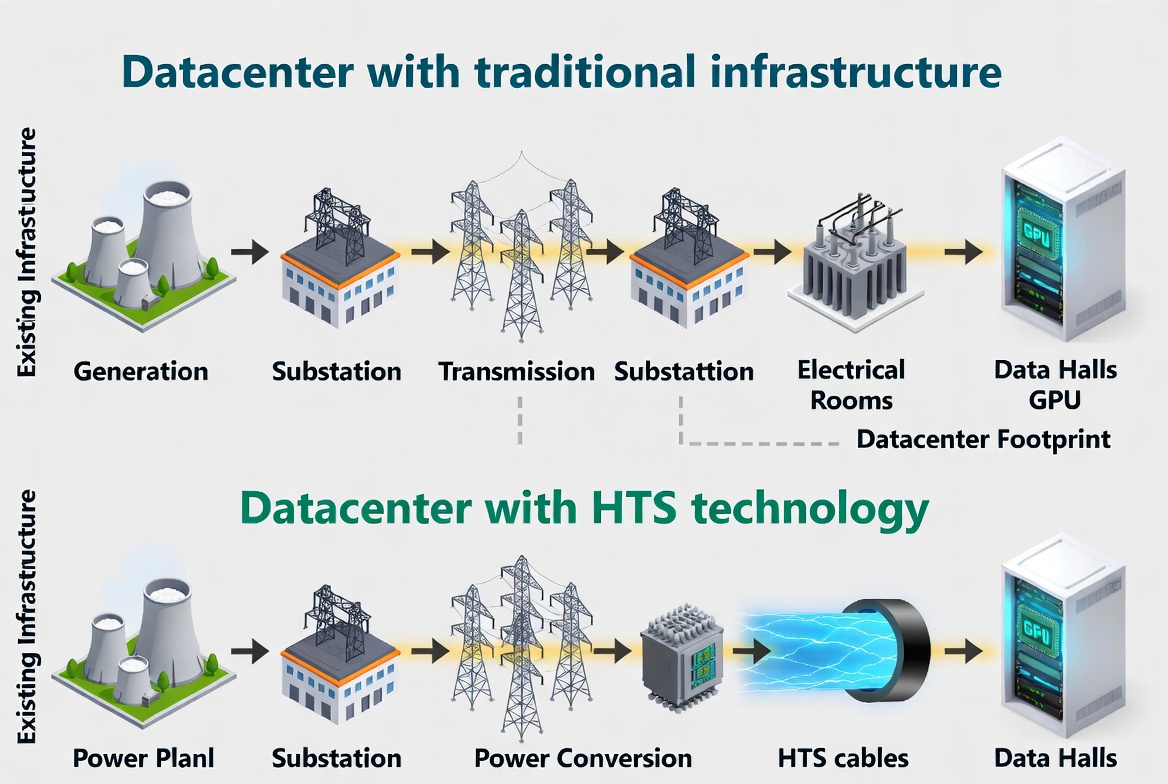
The rise of AI and data-heavy computing is driving a sharp increase in power demand. Data centers need reliable and efficient ways to handle this load.
Superconducting cables increase electrical capacity without increasing physical size. This means more power can be delivered within the same footprint. In some cases, the overall space required can even be reduced. This makes it easier for facilities to scale up without expanding their physical layout.
Large Metropolitan Areas
Expanding power in large cities is complex. It often requires upgrades to generation, transmission, and local distribution systems. Space constraints and existing infrastructure make these upgrades difficult.
High-temperature superconducting cables help solve this problem by delivering high power levels in a compact space. This allows cities to increase capacity without major construction. It can also reduce the strain placed on shared infrastructure that supports homes, schools, hospitals, and businesses.
Transmission Line Infrastructure
Superconductors provide a major advantage in power transmission. Because they operate with little to no electrical loss, they improve overall efficiency across the board.
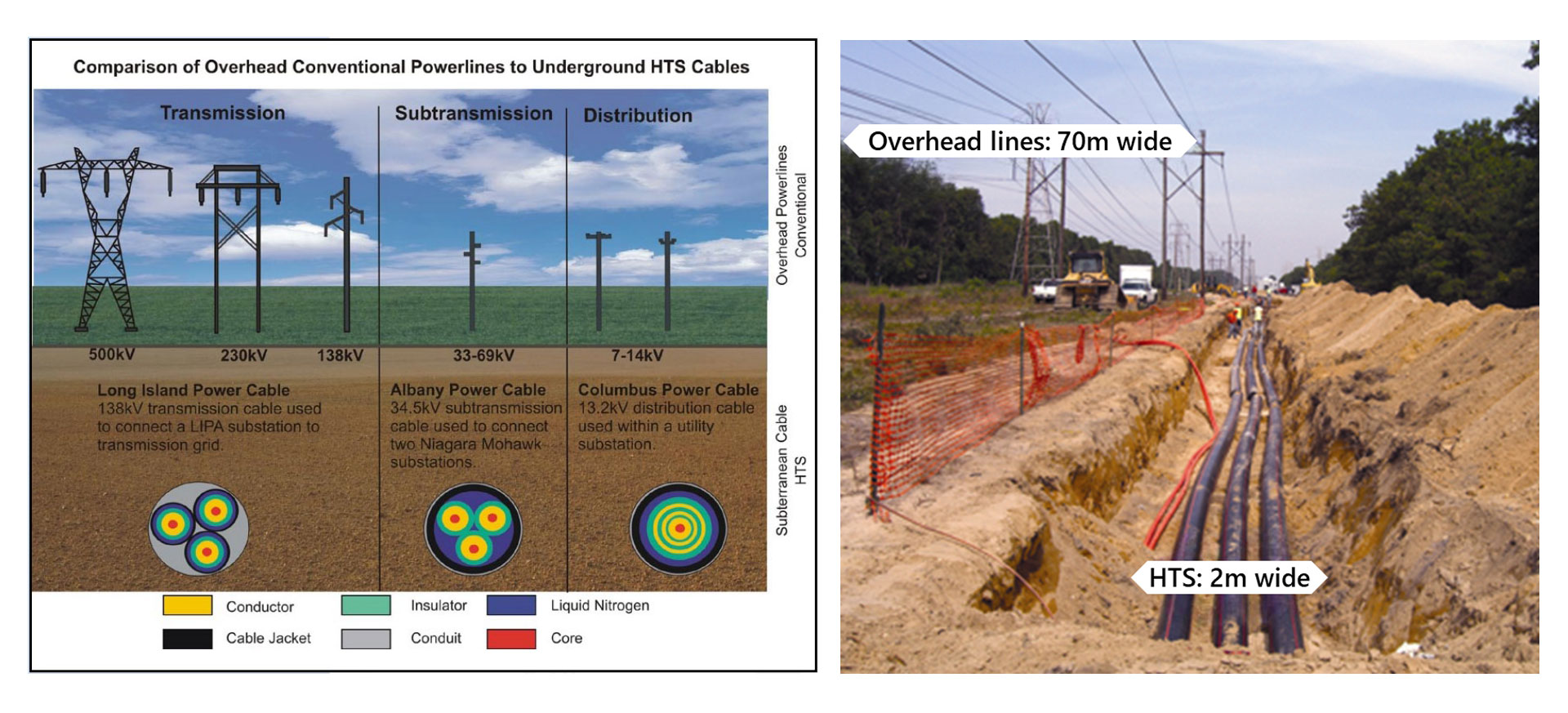
HTS systems can move large amounts of power using less space than traditional lines. They also reduce voltage drop over distance, which helps maintain stable power delivery. They can even provide fault current limiting capabilities, adding an extra layer of protection to the grid.
Unlike conventional transmission systems, which often require large corridors, tall towers, and expansive substations, superconducting systems are more compact and less intrusive. They can deliver the same amount of power at lower voltages, which reduces the need for wide right-of-ways and large-scale infrastructure.
Reduced Footprint, Increased Reliability, and Less Maintenance
Superconductors allow electricity to flow without resistance. This improves efficiency and makes it easier to increase power capacity without major system changes. When combined with gas-insulated distribution equipment, even dense urban areas can expand power delivery without building new substations.
Gas-insulated switchgear offers a clear space advantage. It takes up far less room than traditional air-insulated systems, which helps reduce the need for expensive real estate. It is also highly reliable and requires less maintenance than older technologies such as air blast or oil-based breakers.
Related: SF6 Gas Alternatives for a Sustainable Energy Future
In gas-insulated systems, multiple components are sealed within a gas-filled enclosure. This design protects internal parts from dust, moisture, and other environmental factors. It also prevents interference from external elements like animals. As a result, these systems can operate for long periods with minimal maintenance.
Next-generation superconducting transmission lines can deliver significantly higher capacity than conventional lines at the same voltage level. When combined with gas-insulated distribution and modern transformer networks, they enable highly reliable power delivery with greater capacity and a smaller overall footprint.
References
- HTS Power Technology for Future DC Power Grid
- HTS Cable Projects
- Can HTS transform the power infrastructure of data centers?
- High-temperature Superconducting Cable Technology and Development Trends
- Superconducting Cable Construction and Testing – EPRI Technical Report
 With over 20 years of experience in power systems testing and maintenance, I am a seasoned professional dedicated to enhancing operational efficiency. I excel in improving processes, systems, tools, research, training, and technology implementation. Contact me to see how we can keep your systems running at peak performance.
You may also like...
- Enhancing Reliability: The Role of Overhead Power Line Monitoring in Preventing Failures
- Infrared Insights: The Path to Preventing Electrical Failure with IR Technology
- Securing Test Data and Creating Immutable Trust with File Validation Over Blockchain
- Personal Protective Grounding: More Than Meets the Eye
- Protecting Critical Electrical Infrastructure from Attack